
Second Hermeneutic
Free on SceneLog — log in or create an account to track it.
Overview
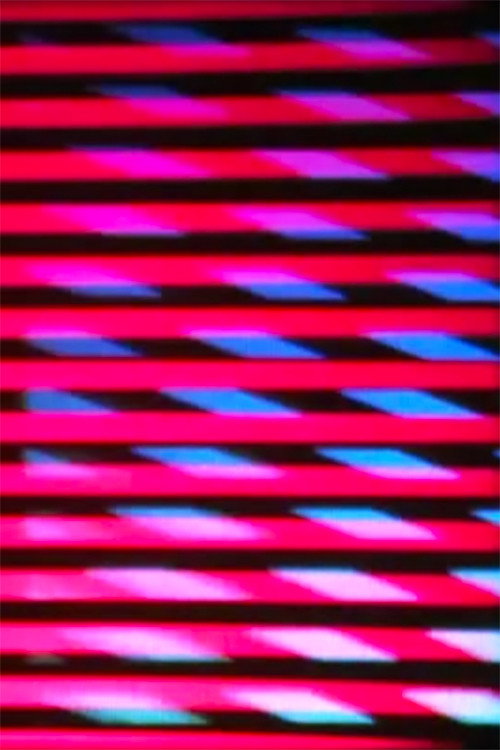
In Second Hermeneutic, the visuals are created by a pair of graphic animated films projected so that they partially overlap, the animated bands and fields of color linked audibly to the soundtrack in an immediately synchronous way – as something appears on screen, there is a directly audible response. This sound emerges from his use of the video camera’s visual output run through his audioboard to the speakers: it is an analogue sonification of the video signal. As a purely audio-visual experience, the performance might seem similar to such early expanded cinema works as Paul Sharits’ Shutter Interface (1975) where a series of four film projectors overlap their frames, creating juxtapositions and combinations on screen – as in Second Hermeneutic; however, the difference is instantly apparent in the performance itself – the soundtrack emerges from the interaction of projected imagery resembling the bands and bars of an optical soundtrack, but with the addition of saturated color.
Comments
Be the first to comment.
Leave a comment
Your email won't be published. Comments are reviewed before they appear.